

What "Reconciled" Proves, and What It Leaves Untested
Reconciled means the bank agrees with the books. Right means the file tells you something true about your business. The first does not imply the second, and most work stops at the first.
Your bookkeeper sends the monthly file and the bank account reconciles to the cent. Your accountant files the return on time. The statements balance, payroll clears, and the forecast adds up.
Every file is finished. You still cannot say which job made money, or why the tax bill looks like that, or whether to take the contract in front of you.
Nothing is broken. That is what makes it hard to find.
Two tests, and most work passes only one
The first test belongs to the service. Does the account reconcile, does the return comply, do the statements balance, does the pay run clear, does the model calculate. Software and process settle that one, and the answer shows on a screen.
The second test belongs to you. Does the file describe your business well enough to act on. No screen settles that one, and a CPA answers for it.
Radiant Skies applies both tests to every file, in every service. This article shows what the second test catches.
What this looks like in practice
I spent 15+ years as a Controller, and this gap turned up in every company I worked in. It rarely arrived as an error. It arrived as work that satisfied its own service and told the owner nothing.
Five of those examples make the case plainly, one for each service. The article takes them in order of how hard the gap is to find. The first shows itself to anyone who opens the file. The last one leaves no error at all, and the work still fails.
Reconciled Is Not the Same as Right: The Coding Error Anyone Can See, and Nobody Checks
One payment, one wrong account
A $350 payment went to a cleaning contractor. The bookkeeper coded it to computer expense. The bank shows the same $350 withdrawal, the account reconciles, and your computer costs carry a cleaning bill for the rest of the year.
Nothing conceals this error. Anyone who reads the ledger against the invoices finds it in minutes. It survives because nobody reads the ledger against the invoices.
Three errors that behave the same way
The wrong period
A December invoice recorded in January shifts revenue between two fiscal years and two GST returns.
The wrong tax code
An exempt purchase coded as taxable clears the bank identically to a correct one.
No document behind the entry
An entry with no invoice rests on somebody’s memory, and memory fades within weeks.
Why reconciliation catches none of them
Reconciliation compares amounts and dates against a statement, and it never opens an invoice. A file that nobody reads against its own documents fails the second test in its first month. Our bookkeeping services in Calgary set the controls that catch these errors.
Reconciled Is Not the Same as Right: When the Reconciliation Itself Hides the Error
What the reconciliation does when it works
A bank reconciliation takes two balances produced independently, one from QuickBooks® Online and one from the bank. They differ for honest reasons, and the reconciliation names those reasons.
The worked example
The accounting system opens the month at $1,000. It records withdrawals of $350, $215, and $409, totalling $974. It records deposits of $390 and $1,100, totalling $1,490. Net movement is $516, so the book balance closes at $1,516.
The bank statement closes at $825. Two timing items explain the whole $691 gap: the $409 cheque has not cleared, and the $1,100 deposit has not landed.
- Book balance $1,516
- Bank statement balance $825
- Less: outstanding cheque ($409)
- Add: deposit in transit $1,100
- Adjusted bank balance $1,516
Four ways that same reconciliation reaches zero and misinforms
1. A compensating error
The bank charges $2,000 and nobody records it. A different $2,000 entry goes in twice. The two errors cancel, and both records stay wrong.
2. The wrong transaction cleared
You paid two suppliers $1,200 each in the same week. The bank cleared the first one. The bookkeeper ticked the second one off against it.
The reconciliation balances, because the amounts match. Your books now show the wrong supplier paid and the other invoice still outstanding, and the supplier who waited calls you next month.
3. A stale item covering a fresh error
A cheque outstanding for eight months offsets an error made this month, and the current reconciliation looks clean.
4. A forced adjustment
Somebody posts a reconciliation adjustment. The difference disappears, and the missing transaction stays missing.
What that means when you read a reconciliation
Amount alone never identifies a transaction, and age matters as much as amount. A balance that agrees is a file passing its own test. A balance that agrees is not a file describing your business.
Our bookkeeping services in Calgary close the month with the reconciliation and a CPA read.
Balanced Is Not the Same as Right: Intercompany Accounts That Hide Every Entity
Five entities, one clean consolidation
I joined a group of five entities whose consolidated statements balanced every month. The intercompany accounts underneath them did not agree.
The bookkeeper posted the journal entries across all five sets of books. Intercompany sales, product transfers, service transfers, and dividends went in on one side. The corresponding entry on the other side did not match. One entity billed another for a service and recorded the receivable. The paying entity recorded the cost against a different account, or recorded nothing until somebody chased it. Product transfers moved between entities at a value one side used and the other did not.
The same bookkeeper prepared the eliminations. Any difference got an entry that made the consolidation agree. The group always balanced, and the entity records underneath stayed wrong.
What the owners could not see
The consolidated statements balanced every month. No entity could reliably show what it owed, what it was owed, or what it had earned.
Nobody could price a service transfer, because the cost side carried a different number from the revenue side. Nobody could judge an entity’s margin, because part of its cost base sat in another company’s books.
Dividends added a further problem. An intercompany dividend recorded by the payer and missed by the recipient left the books inconsistent. The difference surfaced only when somebody reconciled the two sides.
The cause and the fix
The bookkeeper had never learned how the two sides of an intercompany entry work across a group. Nobody had set a convention for which account each transfer type used, so each transaction found its own path.
Coaching the role fixed it entity by entity. Each transfer type got one treatment, applied on both sides. The intercompany balances then agreed before consolidation, and the eliminations carried no plug.
A group that balances and five entities nobody can read is one file describing nothing. Our accounting services in Calgary test what each entity says, not only what the group adds up to.
Filed Is Not the Same as Right: The Lawful CCA Schedule That Costs You Tax
Why a correct return can be the wrong return
Capital cost allowance is discretionary. A company claims what it chooses up to the maximum the rules allow, and a claim below that maximum breaks no rule.
A company can therefore under-claim, file an accurate return, and pay more tax for years. No flag rises, because nothing is wrong. The CRA raises questions about claims that are too high, not claims that are too low.
What I found, and what it cost
I found a CCA schedule doing exactly that. The accelerated investment incentive was misapplied, so additions that qualified for an enhanced first-year claim received the ordinary treatment.
Several additions also sat in outdated classes, carrying a lower rate than the current rules gave them. The errors compounded, because an under-claim in one year leaves a higher undepreciated balance that the next year’s schedule inherits.
Every filed return was defensible in law, and the company overpaid for years.
The cause and the fix
The schedule ran on the prior year’s template, and nobody read the budget changes against it. Annual budget training for the accountants closed the gap, and the schedules then matched the rules in force each year.
I hold my own firm to that routine. A defensible return and a right return are different returns. Our tax compliance, planning, and optimization service works to the second one.
Paid Is Not the Same as Right: Payroll That Costs Nothing to a Job
Right at every level except the one that mattered
I joined a company running projects with payroll set at the company level. Every pay run cleared. Deductions remitted on time, and the T4s were correct at year-end.
The payroll records held hours and wages by employee and pay period. They held nothing by job.
A day of work, and nobody could say where it went
Billing a customer meant somebody opening timesheets and working out which project each worker’s day belonged to. Reconciling labour cost against a customer invoice took a person a day for a handful of jobs.
The pay run described the employee. It described no job, so the labour cost behind an invoice stayed a reconstruction rather than a record.
The fix, and what changed
I instituted payroll at job level. Timesheets carried a job code, and the pay run coded labour to the job that consumed it.
Customer invoice billing and labour cost reconciliation stopped taking a day, because the payroll record answered the question directly. A payroll file can be correct on every deduction and still describe nothing about the work. Our payroll services in Calgary capture labour at the level your business bills.
Calculated Is Not the Same as Right: The Forecast Nobody Uses
Finance wrote the operational assumptions
I joined a company where accounting prepared the operational assumptions on its own. Volumes, capacity, timing, headcount, and project starts came from finance rather than from the people running the work.
The numbers were internally consistent. Revenue grew at a rate somebody in finance considered reasonable, and costs followed revenue. Nobody in operations had been asked whether the capacity existed to deliver that revenue, or when the projects would actually start.
The model balanced, and the business ignored it. A forecast built on finance’s own assumptions is an Excel exercise.
The cause and the fix
Two causes sat behind it. The previous controller led the function passively, and accounting sat in a silo where entity accountants did not speak to each other and the owners did not speak to accounting.
Leading the change and integrating accounting with operations put the real assumptions into the model. Operations supplied the volumes and the start dates, and the forecast began to describe work the business had actually committed to. The variances then meant something, because a miss pointed at a decision rather than at a guess.
I run client work the same way.
The only test that mattered
No auditor would fault that original model. Every number passed its own test, and the file described a business nobody recognised. Our fractional CFO in Calgary service builds forecasts an owner acts on.
Where to Start
The standard, stated plainly
Radiant Skies applies two tests to every file, in every service. The file has to pass its own test, and the file has to describe your business.
Anybody can produce the first. A CPA answers for the second.
Why I built the firm this way
Every example in this article comes from work I led as a Controller. Five different files, five different services, one lesson. A deliverable can satisfy every rule and still leave an owner unable to act.
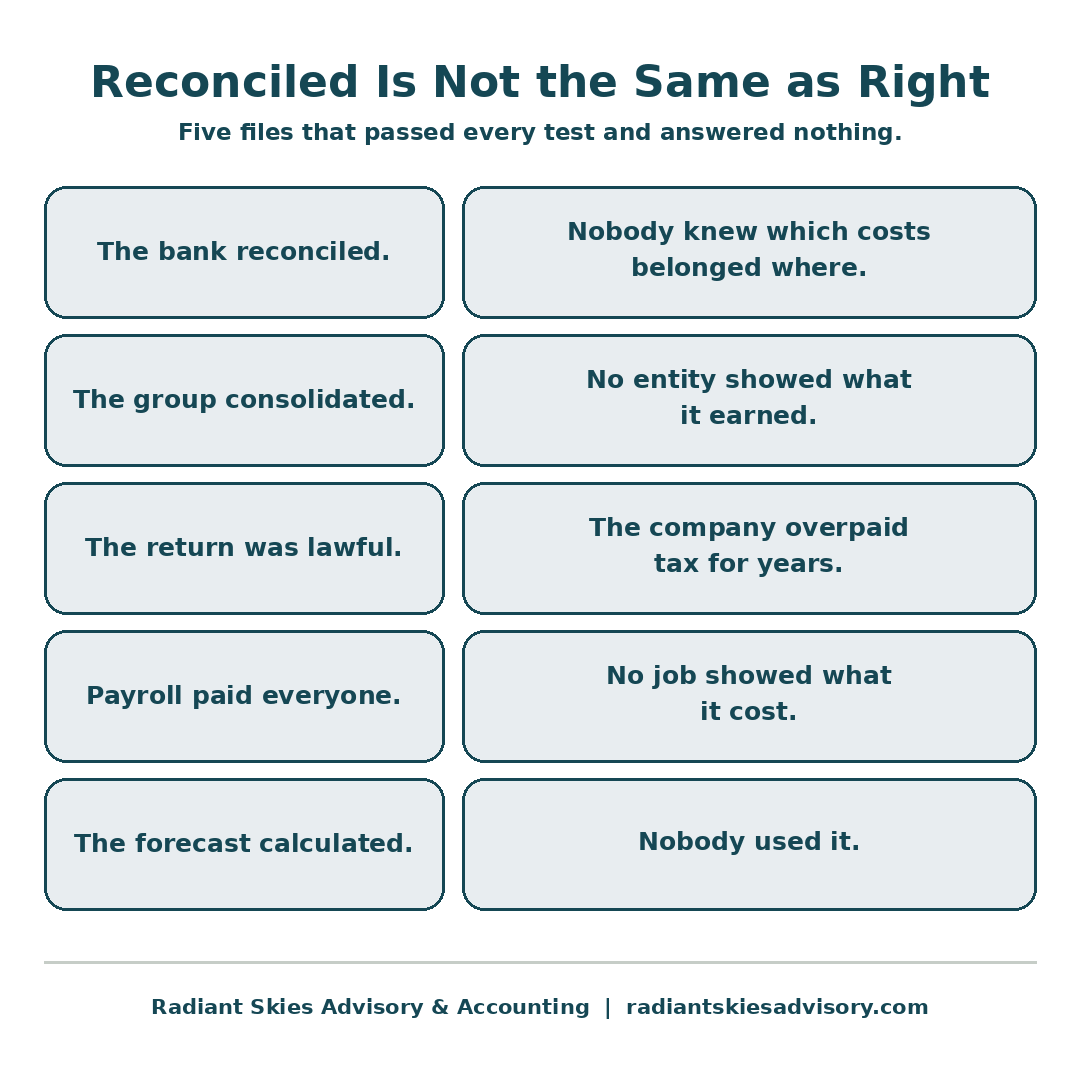
The reconciliation balanced. The group consolidated. The return was lawful. The payroll paid everyone correctly. The forecast calculated. Not one of them answered the question the owner needed answered.
Reconciled is not the same as right, because books can reconcile and mean nothing. Filed is not the same as right, because a return can be lawful and cost you money. Balanced is not the same as right, because a group can consolidate and hide every entity. Paid is not the same as right, because payroll can clear and cost nothing to a job. Calculated is not the same as right, because a forecast can add up and change no decision.
I built Radiant Skies to close that gap. A file that balances and explains nothing has failed, and that judgment holds whatever the service, whatever the size of the business, and whatever the month.
About the Author
My name is Waheed Khan. I am a seasoned senior financial leader and Controller, and the founder of Radiant Skies Advisory & Accounting, a Calgary CPA practice. Holding an MBA in Finance from McGill University alongside my CPA and CFA credentials, I specialize in helping businesses reduce financial guesswork, optimize cash flow, and regain operational control. My goal is to handle the heavy lifting of compliance and strategy so you can focus on growth.
This article is general information, not accounting or tax advice for your specific situation. Rules and thresholds change and depend on your circumstances; please confirm anything relevant to your business with your accountant.
Trademark Note: QuickBooks® Online is a registered trademark of Intuit Inc. Radiant Skies Advisory & Accounting is an independent professional services practice and is not endorsed by, sponsored by, or affiliated with Intuit Inc.