

How Can I Tell If My Bookkeeper Is Doing a Good Job — Without Auditing Their Work?
You can tell that your Calgary bookkeeper is doing a good job by looking at your QuickBooks® Online file and the work habits of your bookkeeper.
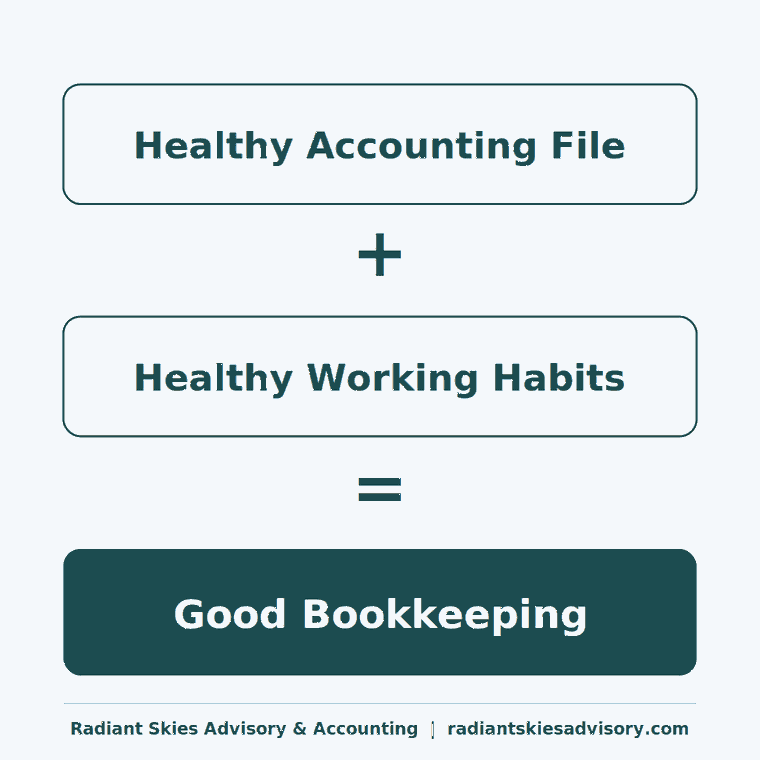
This can be summarised in the equation: Healthy QuickBooks® Online File + Healthy Working Habits = Good Bookkeeping Job
Healthy Accounting File - Four Checks
I have managed and supervised bookkeeping in my Controller and senior financial leadership roles for 15+ years across Alberta’s energy, real estate, construction, manufacturing, industrial machinery and equipment, and professional services sectors, as described on our About Us page.
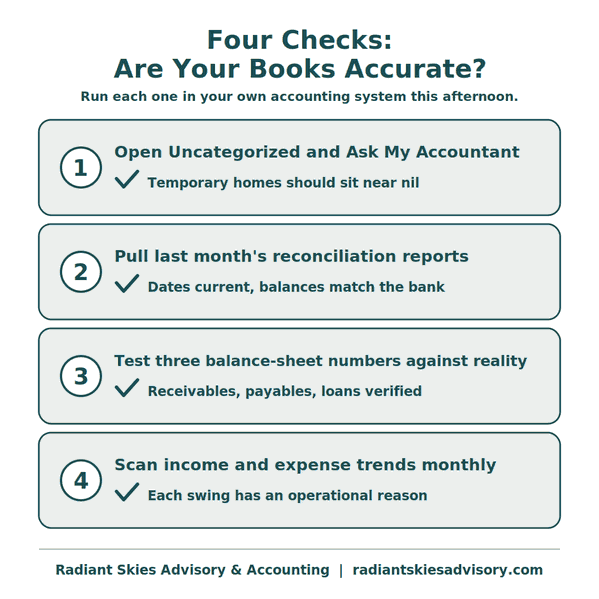
In these roles I have worked directly with the business owners. Over the years, I have allayed business owners’ anxiety about the health of their accounting system through four accounting system file checks.
I have described those checks in our article: How Do I Know If My Books Are Actually Accurate? The visual representation of these checks is given here:
In our current article, I will describe the healthy working habits that complete the other half of a good bookkeeping job.
Healthy Working Habits - Five Signs
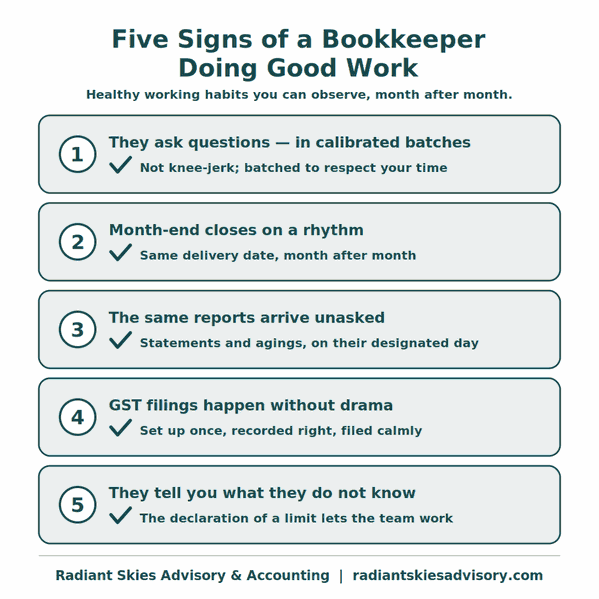
You observe these signs — the healthy working habits — over a period of time. In contrast, you can run the four file checks in an afternoon. The signs take longer because they are behaviours, and behaviours reveal themselves across weeks, not hours.
Behaviours offer insight into the person’s intention. So, good behaviours generally imply good work. In our case too, whether you manage bookkeeping in Calgary yourself or use a bookkeeper, good bookkeeping behaviours are the signs of a good bookkeeping job.
1. They Ask You Questions — Regularly and in Batches
These questions are not for their own sake.
Please recall Uncategorized and Ask My Accountant accounts from our article: How Do I Know If My Books Are Actually Accurate? These accounts are the temporary home of the financial transactions until the bookkeeper finds answers to where these transactions should go. You and your staff have these answers. So, a bookkeeper must ask you questions to clear these accounts.
Similarly, some simple-looking transactions carry different treatments. Meals and entertainment are generally 50% deductible. In some cases, these are 100% deductible. Bookkeepers must ask questions to keep the treatment clear for these seemingly simple meals and entertainment transactions.
The list goes on; a single article cannot cover it. It is not possible to cover the whole plausible list of questions here.
So, good bookkeepers ask pointed questions. But they should respect your time. A question should not be a knee-jerk reaction. It should be part of a calibrated batch that enables you to answer efficiently.
2. Month-End Closes on a Rhythm You Could Set a Watch By
Discipline wins most struggles. Timeliness suggests maintained discipline. In accounting, numbers lose meaning if they are not timely. Good bookkeepers and accountants keep this standard at the core of their work ethic.
A month end arrives on time only when each activity of the bookkeeping or accounting cycle runs at its prescribed moment. Our article – What Does a Bookkeeper Actually Do for Your Business? – describes the cycle for your business.
The activities of the bookkeeping cycle run like the notes of a well-rehearsed piece of music. Each sounds at its moment, delivering the same result month after month.
Meanwhile, the quality of the work stays consistent. You can see this by observing that your bank account balances match your financial statements. The customer and vendor statements are up to date. Payroll runs on its dates too, whether in-house or through payroll services in Calgary. Consistent quality keeps the books ready for the CRA and for your Calgary tax accountant. At a high level, our article – How Do I Know If My Books Are Actually Accurate? – lists those checks.
3. You Receive the Same Reports Every Month — and They Arrive Unasked
A later article in this series will cover the reports in detail.
In summary, you should receive the reports every month at their designated time. A business owner’s reporting package generally includes the balance sheet, income statement, accounts receivables and accounts payable aging reports. These reports should arrive at their designated time without you having to ask.
Missing reports, or reports that arrive at unpredictable times, are not good signs. Usually this means the month-end does not complete on time. If this is the case, the very validity of the reports may be in question. Small business bookkeeping can and should match the reporting standard of big corporations.
4. GST Filings Happen Without Drama
Bookkeepers should set up the GST system in your QuickBooks® Online file properly. Once set up correctly, the system generally runs smoothly. All the bookkeeper has to do is watch the system do its work.
This is one half of how GST works. The other half is how the transactions are recorded in the system. Both halves need to work in sync to keep you on side with CRA.
Take meals and entertainment again. Its GST treatment follows income tax treatment. In most cases, half the expense is deductible for income tax. Likewise, half the GST paid on it is recoverable as an Input Tax Credit (ITC). Your Calgary tax accountant can advise when different tax treatment applies. The expense must be set up properly in the GST system, and each transaction recorded appropriately.
When the two halves work together — and the habit of timeliness holds — GST returns file without drama. Tension around GST filing is worth a question.
5. They Tell You What They Do Not Know
The behaviours are intertwined. We can only ask good questions when we freely admit what we do not know. We have already seen why it is vital to ask questions.
Bookkeeping, accounting services in Calgary, and fractional CFO services form a continuum of work, skills, and experience. In our article – What Does a Bookkeeper Actually Do for Your Business? – we have summarised the boundaries of these three roles.
When something falls outside a role’s boundary, the person in that role must say so freely — to you and to the rest of the team. That is the essence of teamwork. We complement and support each other.
Hockey shows this well.
A goaltender who skates out to play forward has left the net open. A defender who ignores their zone to chase goals has abandoned their job. Each player excels precisely because each stays within a role and trusts the others to cover theirs. The goaltender who shouts “screen, I cannot see” is not showing weakness. They are giving the defence the information they need to do their part. The declaration of a limit is what lets the team function.
Questions Worth Asking Your Bookkeeper This Month
Bookkeepers, accountants, and Chief Financial Officers (CFOs) are all professionals. As professionals, we welcome questions from our stakeholders, including our clients. As a small business accountant in Calgary, I would rather answer a question than see it go unasked. You should ask your bookkeeper, your accountant, and your CFO questions about month end and your financials.
Such questions are encouragement; someone cares about our work. They are checks too; someone watches it. Our article — How Do I Know If My Books Are Actually Accurate? — discusses this in more detail.
This article concerns bookkeeping, so as part of your routine, ask your bookkeeper:
• What is the balance of our Uncategorized and Ask My Accountant accounts?
• When was the reconciliation of bank and credit cards performed?
• Were the reconciled amounts equal to the bank and credit cards statement?
• What are the balances of our long-term loans?
• Do the loan balances match the lender statements?
• Is there any amount owed to us, or due by us, for more than 90 days?
Every situation is unique and questions are endless. The few stated above should give you an idea of what to ask.
Your Assessment — and When It Should Worry You
Your observation of the behaviours, and the answers to your questions, are how to evaluate a bookkeeper’s work.
Recall the equation from the beginning of this article. A healthy QuickBooks® Online file and healthy working habits equal a good bookkeeping job.
If you see the right behaviours and receive satisfactory answers, things are generally fine. The framework is not definitive, but in most cases it serves.
Potential Moment of a Thorough Inspection
If, instead, you see that:
- Reconciliations are not carried out, or the reconciled balances do not match the bank and credit card statements.
- Financial statements are late or never arrive.
- Vendors complain about non-payment of invoices you believe you have paid.
- Customers are not comfortable with the statements they receive.
- You see trends in income and expenses that you cannot relate to your operations.
- GST reporting is a struggle.
- Your bookkeeper does not ask enough questions.
- You are never aware of the things that your bookkeeper does not know.
These are the signs of bad bookkeeping, and this may be the moment for a thorough inspection.
A Moment of Reflection
Before you act, take a moment of reflection. Are you communicating well with your bookkeeper?
- I have walked many a business owner through the barriers their own lack of communication creates. That deficiency can trip their support staff, including the bookkeeper. A simple check: Does your bookkeeper get expense receipts on time? If not, the whole bookkeeping cycle may stall. See our article: How Do I Know If My Books Are Actually Accurate?
- Does a disciplined batch of questions from your bookkeeper receive a prompt response from you?
The inspection will have its full meaning only after the moment of reflection.
What This Assessment Cannot Tell You
This article seeds a direction for you: Healthy Accounting File + Healthy Working Habits = Good Bookkeeping
Our article — How Do I Know If My Books Are Actually Accurate? — provides a framework to gauge the health of the books.
The five signs of healthy working habits are how to evaluate a bookkeeper’s process.
You have your own experience. Add it to the thought process the equation strives to stimulate.
Your Business — Your Priority
Your business operations are your priority. You would rather spend time on increasing sales, negotiating a better purchase deal, framing an acquisition. That is exactly how it should be.
If you would rather have the whole equation — the healthy file and the healthy habits — handled for you, that is the work we do. Outsourced bookkeeping is how most of our clients get there. Our work spans across businesses in Calgary, Cochrane, Chestermere, Okotoks, and Airdrie, as described on our How We Work page.
If you are looking for bookkeeping services in Calgary, Cochrane, Chestermere, Okotoks, and Airdrie, start with a free, no-obligation discussion.
About the Author
My name is Waheed Khan. I am a seasoned senior financial leader and Controller, and the founder of Radiant Skies Advisory & Accounting, a Calgary CPA practice. Holding an MBA in Finance from McGill University alongside my CPA and CFA credentials, I specialize in helping businesses reduce financial guesswork, optimize cash flow, and regain operational control. My goal is to handle the heavy lifting of compliance and strategy so you can focus on growth.
This article is general information, not accounting or tax advice for your specific situation. Rules and thresholds change and depend on your circumstances; please confirm anything relevant to your business with your accountant.