

What Does a Bookkeeper Actually Do — and How Do You Know It Is Being Done Right?
Bookkeepers record and organize financial transactions of a business completely, accurately, and in a timely manner. That is bookkeeping for business in one sentence.
Financial transactions are the consequence of the business activity. Therefore, record of financial transactions is in fact a record of business activities in financial terms. In practice, that means capturing receipts and supplier bills. Each expenditure is then recorded in the right asset, liability, equity, income or expense account.
In addition, bookkeepers are responsible for managing the general ledger and trial balance at a basic level. This entails basic reconciliations like credit cards, bank accounts, loan accounts reconciliations. Additionally, they may also be responsible for tracking and filing the GST in time.
Quality of Bookkeeping Work
The above describes the bookkeeper duties and responsibilities in their basic form. However, quality of work is at least equally important if not more:
- The financial transactions must be completely recorded.
- Imagine if only 1% of the transactions are missed. This may result in financial chaos. Income and expense will not make sense. A few vital supplier payments may be missed. GST filing may not be acceptable to CRA.
- Also, the expenditures and receipts must be classified to the correct accounts.
- Two bookkeeping examples: a shareholder loan cannot sit in an expense account, and an expense cannot sit in an asset account.
- The financial activity must be recorded in the period in which it takes place.
- This is particularly tricky at year ends or GST reporting period end. At this juncture, improper timing of recording financial transactions can adversely impact validity of your tax position or loan covenants.
In short, bookkeeping lays the foundation for a business’s financial architecture. Bookkeepers’ education and training prepare them for this foundational work. That work is the accurate recording and organizing of the business’s financial transactions. Consequently, without this vital work the downstream work of accountants and Chief Financial Officers (CFOs) will not make any sense.
You may look at the training and practical experience requirements for bookkeepers at Canadian Institute of Bookkeeping. Your look will confirm that professional bookkeepers are trained well to organize and record the financial transactions.
For a look at what bookkeepers can do for you, see our bookkeeping services in Calgary.
What a Bookkeeper Should be Doing for You Every Month
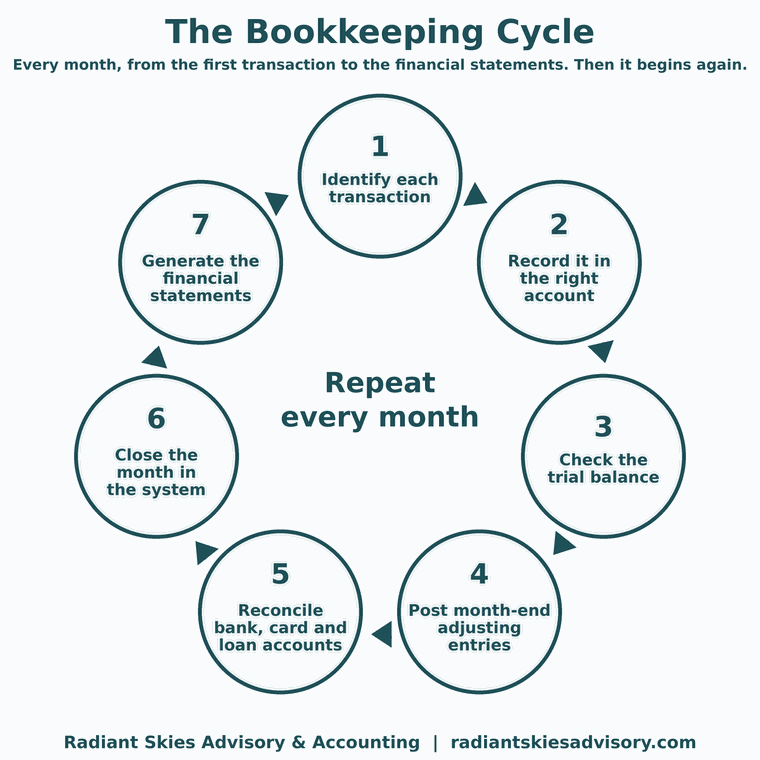
Owners often ask me what is the work of a bookkeeper month to month. The cycle below is the answer. Every month bookkeepers ensure that all the financial transactions of a business in a given period are recorded in their appropriate accounts. Technically, these monthly bookkeeping tasks are referred to as the bookkeeping cycle, or the accounting cycle.
Briefly, the steps in the bookkeeping cycle for small business are as follows:
- Identify what each transaction is.
- It is straightforward in some cases such as a bill or a receipt. It requires judgement in some such as personal expense or an asset purchase.
- Bookkeepers then record properly identified transaction in appropriate account.
- To ensure that the entries are properly recorded, the bookkeepers keep an eye on the trial balance all the time.
- In accounting software that test can be done by a click of a button.
- To close a month properly, bookkeepers need to carry out basic adjusting entries such as recording pre-paid accounts journal entry, depreciation journal entry.
- Execute basic checks on the general ledger such as reconciling bank statements, credit card statements, loan accounts.
- Properly close the month in a financial accounting system such as QuickBooks® Online.
- Final step is to generate the financial statements.
- If the steps in the cycle are followed, the generation of financial statements is a breeze.
This concludes a basic bookkeeping cycle and then the activities start from the beginning. Radiant Skies, the small business bookkeeping service in Calgary, runs this cycle for you twelve times a year.
Additional bookkeepers' duties:
In addition to the basic bookkeeping cycle, the bookkeepers track the GST collected and paid. They file the GST return at its required frequency. Above all, tracking GST collected and paid (Input Tax Credits – ITCs) is important. The net difference of both determines the GST refund/remittance for each GST reporting period. It keeps you onside with CRA and you do not lose your hard-earned ITCs.
Bookkeeping engagements may include payroll services. Bookkeepers then execute the pay run, track CPP and EI, remit the payroll deductions to CRA, submit T4s to CRA and issue T4s to the employees at year end. Payroll requires sending Record of Employment (ROE) to the departing employees. If you pay company benefits, then tracking the benefits is part of the payroll system.
Bookkeeper Duties vs Accountant Duties vs CFO Duties
Bookkeeper Duties vs Accountant Duties
A lot of business owners ask me, how does an accountant differ from a bookkeeper. As a small business accountant in Calgary, I hear it most often at year-end. Simply put, the bookkeepers record the financial transactions that have happened in the past. The result of that record is financial statements that you get every month. Accountants use the recorded transactions to analyse and then explain the past.
Of course, bookkeepers may provide the analysis too. How, then, will this be different from the accountant’s analysis? It comes down to the depth of training and experience. I am not saying that bookkeepers cannot train themselves to the level of training the accountants receive. For sure, they can. However, from the very beginning, accountants’ professional curriculum and experience requirements include extensive analytical training. You may check out the accountants’ training and experience requirements at CPA Alberta website: Become a CPA.
From the very first day in their career, accountants are trained to think analytically. Then from their very first job the accountants are required to demonstrate analytical prowess, put in place the controls that monitor the quality of bookkeeping.
So, the small business accountant can very well explain to you:
- The shift in your profit margins.
- The profitability of each job or department, past cash flow variations.
- Accountants also plan budgets and carry out month over month variance analysis.
- The tax accountant in Calgary is well equipped to provide tax compliance, planning, and optimization services which go beyond recording of income and deductions.
- They plan your tax strategies.
- They are trained to provide consolidated financial statements of your group companies, carry out inter-company account reconciliations.
For a look at what accountants can do for you, see our accounting services in Calgary.
Accountant Duties vs CFO Duties
In most cases, accountants are appointed as Chief Financial Officers (CFOs). In this capacity, they are the heads of the Accounting and Finance of the organization. You will get a better understanding of CFO work from our fractional CFO services in Calgary page.
CFOs provide long term financial perspective, a road map to the business’s prosperity and well being. CFOs report to the company owners and the CEOs.
I have worked for 15+ years in roles that reported to the company owners and in senior financial leadership roles.
To get a perspective about my career as a Calgary CPA, see our About Us page.
In these roles, I took the work of bookkeepers and accountants and used their work to:
- Provided insight on where the cash is heading.
- Decided when to hire, when and where to invest.
- Worked with banks to arrange financing for the company.
- Determined the amount of loan the company can carry.
- Guided acquisitions and mergers of the companies.
How to Tell Bookkeeping is Being Done Right
By working in Controller and senior financial leadership roles for 15+ years, I have supervised the working of many bookkeepers and accountants.
I have seen books where every account reconciled to the penny. Yet the profit did not make sense. Meanwhile, vendors complained about missed payments. Customers were unsure what they owed. The GST deadline was a scramble.
Reconciliation is not the same as Right. This is how I describe my standard of work on our How We Work page. This is my guiding principle for determining the health of the bookkeeping and the basis of accounting, CFO work that I am responsible for.
When the Books are Reconciled But Are Not Right
I have come across many business owners that were in this situation. Each had a bookkeeper in Calgary who reconciled every account.
The accounts were reconciled but:
- Financial transactions are booked to the wrong accounts.
- The Input Tax Credits (ITCs) are not tracked correctly, so you lose hard earned money.
- Assets may be improperly classified.
- Your Capital Cost Allowance may not have been properly determined.
- Lease accounting may not be set up properly.
- Company expenses and personal expenses are tangled.
Numbers You Can Trust
I have fixed these situations when I have encountered them. All it needs is to treat it as a situation to fix, and not as a judgement to how the business is run.
First, I take a good look at the situation. Determine the broken link in the chain of the bookkeeping cycle and fix that link.
Then I, clean up the errors that already exist in the system and keep a vigilant watch on the accounting system. The fix of the errors tells us what to watch.
I have carried out this fix numerous times where financial statements were delayed by months and accounting was in chaos.
In every case, the result was the same: numbers that you can trust and the burden that was taken off your shoulders. Our outsourced bookkeeping service takes the cycle off your desk without taking the numbers out of your hands. So, you can concentrate on what you do best – running your business.
That is the standard we hold our bookkeeping in Calgary to, for owner-managed businesses in Calgary, Cochrane, Airdrie, Chestermere, and Okotoks.
About the Author
My name is Waheed Khan. I am a seasoned senior financial leader and Controller, and the founder of Radiant Skies Advisory & Accounting, a Calgary CPA practice. Holding an MBA in Finance from McGill University alongside my CPA and CFA credentials, I specialize in helping businesses reduce financial guesswork, optimize cash flow, and regain operational control. My goal is to handle the heavy lifting of compliance and strategy so you can focus on growth.
This article is general information, not accounting or tax advice for your specific situation. Rules and thresholds change and depend on your circumstances; please confirm anything relevant to your business with your accountant.