

How Do I Know If My Books Are Actually Accurate — and What Can I Check Myself?
Accurate books record every financial transaction in the appropriate account, in the correct period, in a timely manner.
Financial transactions arise from business activities. So accurate books tell the story of your business in financial terms. When the record is accurate, the story makes sense.
In our first bookkeeping post, I described what a bookkeeper should do every month. Any bookkeeper in Calgary you hire should meet that standard. Knowing the standard is one thing. Verifying the work happened is another.
Why Accurate Books Matter
They matter because of what they let you see:
- You know how much money you are making.
- Each job or department shows whether it makes money.
- Cash for the next payroll stops being a guess, whether you run payroll yourself or use payroll services in Calgary.
- Missed vendor payments surface early.
- Receivables show their true status.
- Lenders trust your numbers
- CRA asks fewer questions.
The owners I meet through small business bookkeeping in Calgary feel this need keenly. They frequently ask me, as a small business accountant in Calgary: how do I know if my books are actually accurate? I have worked as a Financial Controller and in senior financial leadership roles for 15+ years, as described on our About Us page. In those roles, I calmed this anxiety many times, using checks the owners could run themselves.
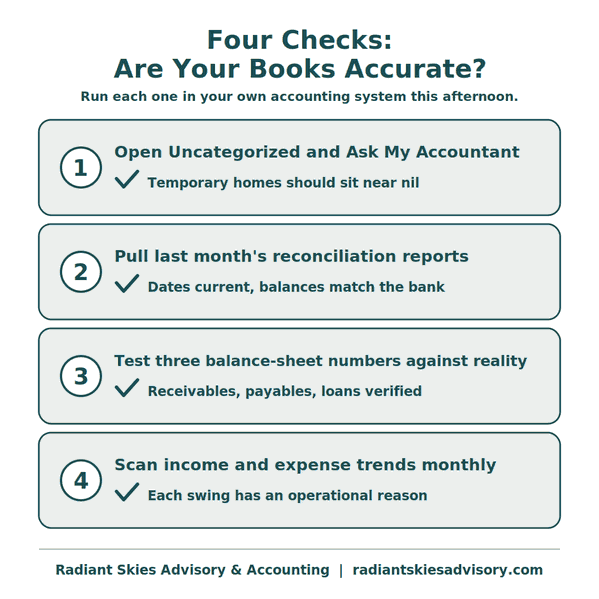
Four Checks You Can Run in Your Own Accounting System This Afternoon
These four checks are the bookkeeping checklist I have used in those conversations. You can run each one in QuickBooks® Online without accounting training.
1. Why is there a huge amount in "Uncategorized" or "Ask My Accountant"?
A large balance in either account drains meaning from your numbers. Here is how.
Uncategorized Accounts
QuickBooks® Online automates much of the coding work, and its AI has sped this up appreciably. When the automation cannot give a transaction a home, the transaction defaults to an Uncategorized account. If the bookkeeper lets automation do all the work, these balances grow.
Ask My Accountant
Ask My Accountant serves a related purpose. A bookkeeper who is unsure about a transaction parks it there. Later, with the right information, the bookkeeper moves it to the proper account. Some QuickBooks® charts of accounts include this account by default. Other bookkeepers create it themselves.
Uncategorized Accounts and Ask My Accountant accounts are legitimate tools. Their purpose is a temporary home until the right information arrives. The emphasis is on temporary.
Why the Balance In Uncategorized Accounts and Ask My Accountant Accounts Matters
QuickBooks® treats coding to these accounts as normal business. Bank and credit card reconciliations are complete. The trial balance still balances. The system still produces financial statements. Yet a large balance in these accounts empties those statements of meaning.
Two examples from practice show how.
Example 1
You purchase a new type of asset for $24,500. QuickBooks® cannot determine the account, so the full amount lands in Uncategorized Expense. Your expenses are now overstated. Your profit, your asset base, and your future depreciation are all understated.
Example 2
A customer sends a payment. The bookkeeper cannot match it to an invoice and parks it in Ask My Accountant, set up as a receivables-type account. On the surface, every number holds. The receivables total is right, so the balance sheet stands. Nothing touched the income statement, so the period result stands too. That apparent correctness invites complacency. Meanwhile, the payment never reaches the customer’s invoice. Month-end statements go out, and that customer receives a statement charging an invoice they have already paid. That is bad for business.
2. Do Last Month's Reconciliation Reports Exist, And Do They Match the Bank Statement?
Bank reconciliation proves that every transaction flowing through the bank has reached the books. It is the first thing I look at when a Calgary bookkeeping file comes to me.
The check takes two minutes. Click the gear icon at the top right of QuickBooks® Online, then click Reconcile. On the screen that opens, click History by Account at the top right. You can now see the reconciliation dates and balances for each account.
Up-to-date reconciliations that match the bank statement suggest a complete transaction record. Missing reconciliations tell a different story. So does a reconciled balance that disagrees with the bank. Either way, transactions are missing or amounts are wrong, and the numbers you see are not a reliable guide.
3. Pick Three Balance-Sheet Numbers and Test Them Against Reality
Your balance sheet mirrors the reality of your business. How to read a balance sheet is a topic for another day. It is also the point where accounting services in Calgary take over from bookkeeping. For now, you only need to gauge a few numbers against what you already know.
You know your operations better than anyone. Consider a month of unusually strong sales. If your receivables balance did not grow that month, the books may be off. The exception is a business that collects cash at the point of sale. You would know if that described yours.
Test a payables balance and a loan balance the same way. Pull your lender statement and compare it to the books. When you test three numbers this way, you will usually get a fair read on the health of your books.
4. Are My Income and Expenses Categorised Correctly?
Every sale should land in an income account. Every expenditure is commonly one of three things: an expense, a capital purchase, or a liability payment. The bookkeeper should record each as such.
Here is a simple test. Look at the monthly trend of each income and expense category. The rise and fall of your operations should broadly match the rise and fall of these numbers. Wild swings in one category usually signal misfiling rather than a real change in spending.
Where a trend and your operations disagree, ask your bookkeeper. A reasonable explanation of timing settles the question. The absence of one tells you something is off.
What Are the Warning Signs That Something Is Wrong with My Books?
Watch for these patterns; each points to mistakes rather than misfortune. Treat them as an addendum to the four-check bookkeeping checklist above:
A Negative Balance That Should Not be Negative
- A negative receivables balance is one example, unless the only item in the customer’s account is a customer credit. A negative long-term loan balance is an even louder alarm.
Round Numbers as A Habit
- A 1,000 or a 700 appears now and then in real books. A pattern of them suggests estimates rather than records.
Persistent Balances in Uncategorized or Ask My Accountant
- We covered above why these should stay temporary.
Asset Values that Never Move
- Depreciation entries change asset values steadily each month. Values static over many months mean nobody is making those entries. Your tax accountant in Calgary relies on those entries for the capital cost allowance claim.
Balances That Look Unusually High Or Low with No Precipitating Event
- Receivables, payables, assets, loans, equity: each should track something in the business you can name.
An Unusually Calm Ledger
- Real business flows move numbers month to month. Near-static income, expenses, and balances across the ledger often signal trouble.
What These Checks Cannot Tell You
This bookkeeping checklist, the four checks and the warning signs together, gives a high-level view. Every business is unique, so not every check applies to every situation.
The Checks Have Honest Limits
The Uncategorized and Ask My Accountant accounts can sit at nil while transactions hide in the wrong accounts. Reconciliations can be current while categories are wrong; accurate bookkeeping needs both. Completeness is the hardest gap: a transaction that never entered the books leaves no trace for you to find. The subtleties of income and expense classification run deeper than any afternoon checklist. Outsourced bookkeeping exists for that layer: the checks stay yours, the classification becomes ours.
These checks look only backwards. Reading what the numbers mean for the road ahead is the work of our Fractional CFO services in Calgary.
Gut feeling detects some of this. It cannot substitute for technical knowledge and experience. Over the years, I have calmed many owners with these checks. I have also told each of them the same thing: an owner’s checks find symptoms, and a trained pair of eyes confirms causes. Our Bookkeeping Services in Calgary page describes what that disciplined monthly work covers.
If your checks raised questions, or you simply cannot tell, treat that as information rather than a verdict. This mirrors how I approach every file, as described on our How We Work page. A short conversation usually establishes whether anything needs a closer look. As a Calgary CPA, I start every file that way, for owners in Calgary, Cochrane, Airdrie, Chestermere, and Okotoks.
About the Author
My name is Waheed Khan. I am a seasoned senior financial leader and Controller, and the founder of Radiant Skies Advisory & Accounting, a Calgary CPA practice. Holding an MBA in Finance from McGill University alongside my CPA and CFA credentials, I specialize in helping businesses reduce financial guesswork, optimize cash flow, and regain operational control. My goal is to handle the heavy lifting of compliance and strategy so you can focus on growth.
This article is general information, not accounting or tax advice for your specific situation. Rules and thresholds change and depend on your circumstances; please confirm anything relevant to your business with your accountant.